

How Busy Season Pressure Impacts Accounting Firms
The accounting industry operates in cycles. Throughout the year, accounting firms manage a steady flow of work, but certain periods create intense workload spikes. These periods are commonly referred to as busy seasons.
Busy seasons typically occur during tax deadlines, financial year-end reporting, and audit cycles. During these times, accounting teams must complete a large volume of work within tight timelines.
For many firms, this creates operational pressure that affects productivity, employee workload, and overall efficiency.
While the demand for accounting services increases during these periods, managing the sudden surge in work can be difficult if the firm’s internal team is already operating near full capacity.
Understanding how busy seasons impact accounting operations is important for firms that want to maintain service quality while protecting team productivity.
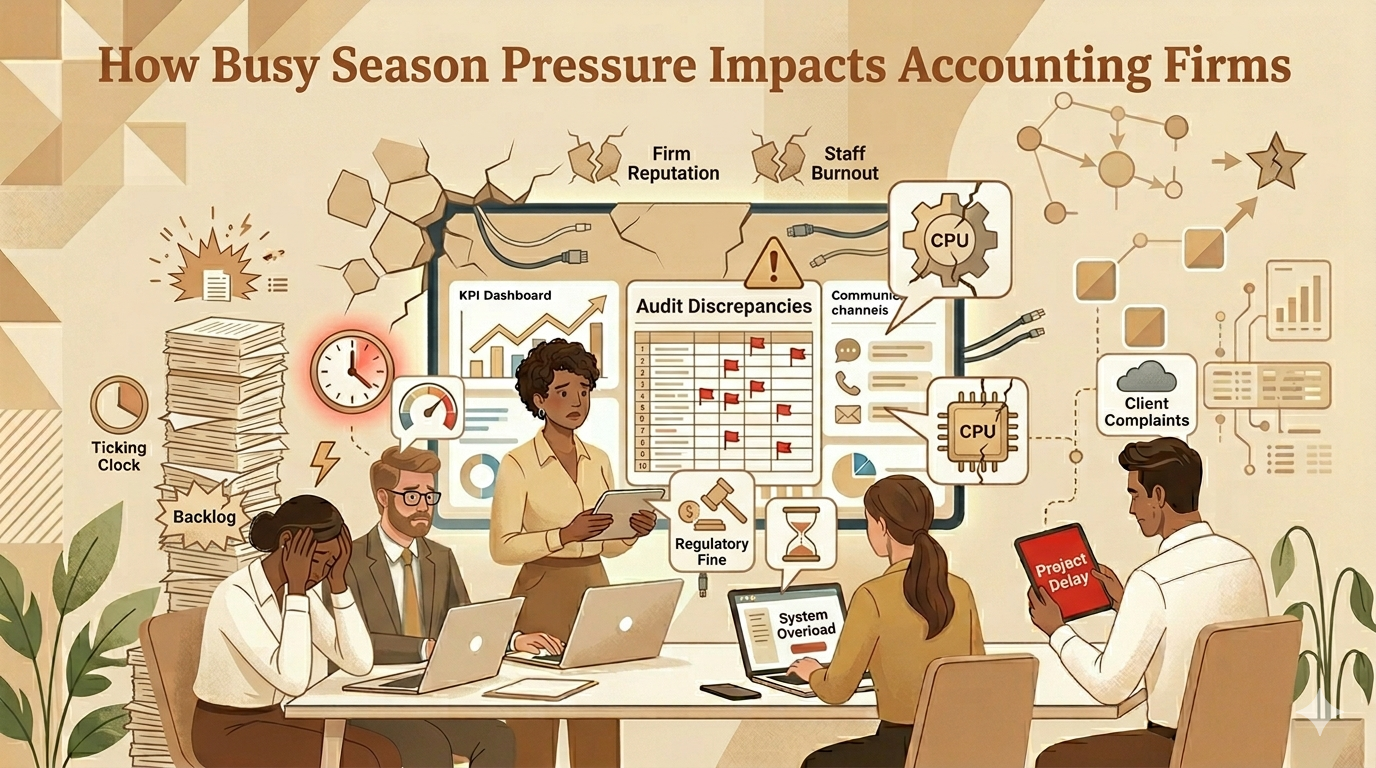
**1. Workload Spikes Become Difficult to Manage**
One of the most noticeable effects of the busy season is the dramatic increase in workload.
Accounting teams must handle multiple responsibilities simultaneously, including tax preparation, financial statement reviews, reconciliations, and client communication.
These tasks often require careful attention to detail and strict adherence to compliance standards.
When the workload increases suddenly, teams may struggle to keep up with deadlines while maintaining the same level of accuracy.
Without proper planning and resource allocation, this situation can create operational bottlenecks.
**2. Extended Working Hours for Teams**
During peak periods, many accounting professionals work longer hours to meet deadlines.
While occasional overtime may be manageable, extended periods of intense work can lead to fatigue and reduced productivity.
When employees consistently operate under high pressure, it can affect both work quality and job satisfaction.
Firms that experience repeated busy-season stress may eventually face higher employee turnover, which adds another layer of operational challenge.
Maintaining a balanced workload structure becomes essential for long-term team stability.
**3. Recruitment Is Not Always a Quick Solution**
At first glance, hiring additional employees might appear to be a simple solution for handling busy season pressure.
However, recruitment in the accounting industry takes time.
Finding qualified candidates, conducting interviews, and completing onboarding processes can take several months. This timeline often extends beyond the busy season itself.
As a result, firms may not be able to rely solely on hiring to address short-term workload spikes.
This creates a need for more flexible operational approaches.
**4. Maintaining Service Quality Is Critical**
Even during high-pressure periods, accounting firms must maintain the same level of service quality for their clients.
Financial records, tax filings, and audit documentation require precision and accuracy.
Any errors or delays can affect client trust and the firm’s professional reputation.
Because of this responsibility, firms must ensure that workload increases do not compromise the quality of their work.
Effective planning and workload distribution play a key role in maintaining consistent performance.
**5. Flexible Execution Support Helps Manage Peaks**
To manage busy-season pressure, many accounting firms explore flexible support models that allow them to increase execution capacity temporarily.
Instead of expanding their permanent workforce for a short period, firms may use external support teams to assist with routine operational tasks.
This approach allows internal professionals to focus on higher-level review and advisory responsibilities while ensuring that execution tasks are completed efficiently.
When implemented effectively, flexible execution support helps firms manage workload spikes without placing excessive pressure on their internal teams.
**Key Points Summary**
- Busy seasons create significant workload spikes for accounting firms.
- Teams often work extended hours to meet deadlines.
- Hiring new employees is not always a quick solution for seasonal demand.
- Maintaining service quality is essential during high-pressure periods.
- Flexible execution support helps firms manage temporary workload increases.
**Conclusion**
Busy seasons are an unavoidable part of the accounting profession. However, the way firms manage these periods can determine their long-term operational stability.
By improving workload planning, protecting employee well-being, and developing flexible execution models, accounting firms can navigate busy seasons more effectively.
Firms that successfully manage seasonal workload spikes are better positioned to maintain client satisfaction, protect team productivity, and sustain consistent growth.